
Blog
Growing traffic in six months
A realistic growth curve and the points where most people give up too early.
- 14 September 2026
- 16 min read

Articles
Growing traffic in six months
Most businesses don’t abandon SEO because it doesn’t work. They abandon it because, in month three, the Search Console graph still looks like a flat line hugging zero. The owner sees invoices, new articles and fixed errors — but no new customers. A perfectly reasonable question follows: “Maybe this just isn’t for us?” And that is exactly when the work stops, often a few weeks before everything invested would have started paying back.
We run projects from scratch and see this pattern all the time: brand-new sites, sites after a redesign, online stores that have lived on paid ads for years. Below is a realistic organic traffic growth curve for the first six months: what happens each month, why traffic doesn’t grow in a straight line, where people most often give up too early, and what to measure so you aren’t making decisions blind.
Why traffic doesn’t grow in a straight line
Most people subconsciously expect a linear return: put in a month of work, get a month’s worth of traffic. Search doesn’t work that way. Between an action and its result sit several delays, and they stack on top of each other.
- Crawling and indexing lag. A crawler has to discover a new page, fetch it, process it and decide whether to add it to the index. For a young site with few links pointing at it, that can take days — or weeks.
- Evaluation lag. Being indexed is not the same as ranking. A search engine needs time and data to understand how well a page answers a query and how far the site can be trusted.
- Compounding lag. Every new article, category or link strengthens not only itself but also the pages around it. That effect only becomes visible once you reach a critical mass of such pieces.
- User-signal lag. Before the system can see that people find what they need on a page, that page has to earn at least some impressions and clicks.
That’s why a realistic curve for a new or neglected site looks like a hockey stick: a long flat stretch, then a bend, then visible growth. The main job of the first few months is to get through the flat stretch without stopping.
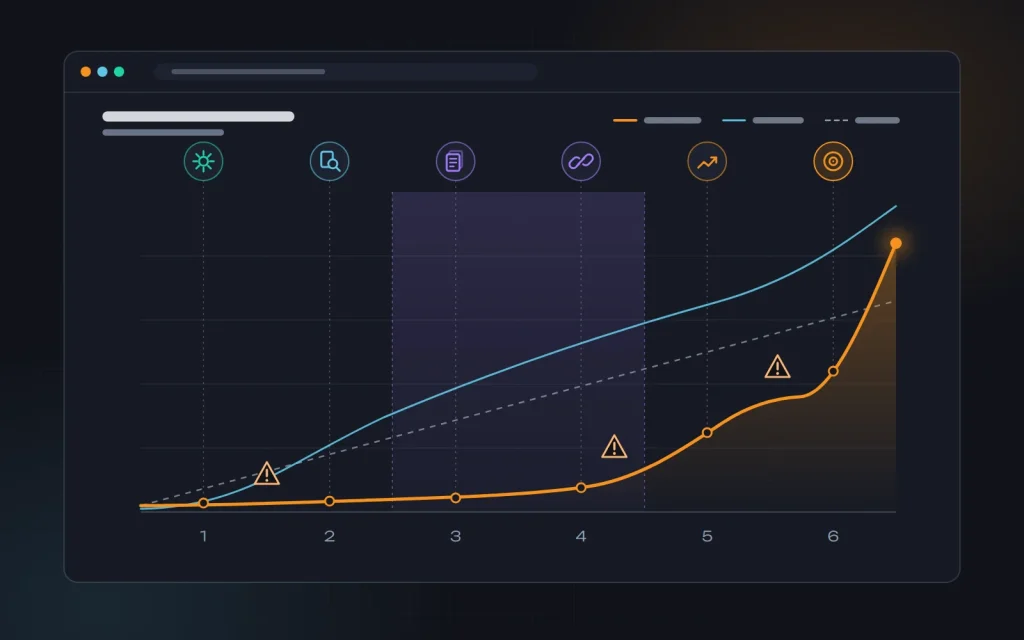
An important caveat: actual numbers always depend on the niche, the competition, the domain’s age and the site’s starting condition. But the shape of the curve, and the points where people quit, repeat in almost every project.
The starting point matters most. A site with several years of history, decent links and a clean reputation that simply had technical problems often responds to fixes within a few weeks: the search engine already trusts it and was merely being prevented from reading it properly. A new domain has no such trust, so its flat stretch is longer. A site that went through a redesign or migration without redirects is a separate case: it first loses what it had and only then starts growing again. So before setting expectations, we establish which of these starting points applies.
Month 1: the foundation nobody sees
The first month is the least visible and arguably the most important. We don’t expect any traffic at this stage. We’re preparing the ground it will grow from later.
- Analytics. We connect Google Analytics 4 and Search Console and set up conversions: form submissions, calls, clicks on WhatsApp, Viber or Telegram buttons, orders. Without this, six months from now you won’t be able to answer “did it pay off?”
- Technical audit. We check whether the site can be indexed at all: robots.txt, noindex tags, canonical URLs, the XML sitemap, status codes, duplicates and mobile speed.
- Keyword research. We collect queries and group them by page. How to do that without paid tools is covered in “Building a keyword map”.
- Site structure. We decide which pages the demand actually calls for and which ones merely duplicate each other.
- Content plan. We set priorities: commercial pages first, then articles that support them.
What will you see in the data? Almost nothing — maybe a few branded impressions. That’s why many people get nervous by the end of month one. But skip the technical fixes and analytics here, and the remaining five months will work worse: you’ll be building on a shaky foundation with nothing to measure the outcome against.
Month 2: indexing and first impressions
In month two we publish the updated commercial pages and the first articles, and set up internal linking. The technical fixes from month one start to “reach” the search engine: errors disappear from the indexing report, and newly indexed pages show up.
A typical Search Console picture at this stage:
- Impressions start to rise — sometimes noticeably, because the site is appearing for dozens of new queries for the first time.
- Clicks are close to zero, because the average position is somewhere on pages three to five of the results.
- Some new pages show “Crawled — currently not indexed” or “Discovered — currently not indexed.”
This is the first point where people give up. The reasoning goes: “We have impressions but zero clicks, so SEO doesn’t sell.” In reality, impressions without clicks are the best signal you can get in month two. They mean the search engine has already connected your site to the right queries and is now deciding where to rank it.
“Discovered — currently not indexed” isn’t a verdict either. For a young site it’s simply a queue: the crawler knows the page exists but hasn’t decided it’s worth fetching yet. If key commercial pages stay in that status for weeks, though, we check three things: do they have internal links pointing to them, do they duplicate each other, and is there enough unique content on them? Most often the cause is one of those three.
What helps speed up indexing: a clean sitemap that lists only indexable pages, links to new pages from the homepage and from sections the crawler visits often, requesting indexing in Search Console for key URLs and, of course, a fast server. Slow sites get fewer pages crawled per visit — see our website speed optimization work.
Months 3–4: the “dead zone” and the compounding effect
This is the most dangerous stretch. Plenty of work is done, articles go out regularly, the first links are in place — yet traffic barely moves. This is where most of the projects that later come to us for a “restart” were dropped.
Why new pages “sit” in positions 20–40
Many SEO practitioners notice that young sites and new pages rank lower for a while than their content quality deserves. People often call it the “sandbox” effect. Search engines have never officially confirmed a separate filter for new sites, but in practice the lag is real: the site has no history yet, few links and little data on user behavior. The system is cautious and tests pages in different positions before settling on one.
As a result, rankings in months three and four often bounce around: a page is at position 14 today, 38 next week, then 19. That’s normal. What’s risky is reacting to every swing by rewriting the copy, changing the URL or swapping headings. Each time you do that, you restart the evaluation.
What to do instead of panicking
- Watch the trend, not the day. Compare 28-day periods, not yesterday versus today.
- Find pages in positions 8–20. They’re your closest candidates for growth. Targeted improvements work here: a better title, answers to related questions, internal links from stronger pages.
- Keep publishing. This is exactly when compounding kicks in: every new article adds topical weight to the whole section. How to write pieces people actually finish is covered in “Writing content for your website”.
- Don’t change strategy every month. One change of course in month three sends you back to the start.
Compounding deserves a closer look. Ten articles published in two weeks and ten articles spread evenly over three months produce different results. Consistency signals a living site, and each new page that links back to earlier ones lifts the entire cluster. So we recommend a steady pace you can actually sustain for months, rather than a burst followed by silence.
Links: a steady pace, not a sprint
External links remain one of the trust signals, and a new site does need them. But links are also where people most often try to “catch up in a month”: they buy a package of a hundred links, get a sharp spike — and then either problems or no effect at all.
Our approach to link pace for the first six months:
| Period | What we do with links | Why |
|---|---|---|
| Month 1 | Google Business Profile, industry directories, social profiles; checking for unlinked brand mentions | Basic signals that the business is real |
| Months 2–3 | A few quality links from relevant sites, partners and suppliers | First external trust in key sections |
| Months 4–6 | A steady, moderate pace: expert articles, inclusion in reviews and roundups, useful resources people link to on their own | An even, natural link profile |
We judge a link not by count but by whether anyone would actually click it. A link from an industry publication people really read outweighs a dozen from throwaway sites. One more rule: links should point not only to the homepage but also to important sections and articles, so authority spreads across the site.
Months 5–6: the curve bends
If the foundation is in place, content has gone out consistently and links have arrived at a sensible pace, months five and six are usually when the curve starts to bend upward. Some pages move from page two of the results to page one, and clicks grow not linearly but in visible steps: the difference in clicks between position 11 and position 7 is far bigger than between 30 and 15.
This is where the third, less obvious quitting point appears. After the first jump, traffic plateaus for a few weeks. The owner concludes either “That’s it, we’ve hit the ceiling” or “It works now, we can cut the budget.” Both conclusions are premature. A plateau after growth is a normal phase in which the search engine consolidates the new rankings. Scaling back right now means stopping the compounding effect just as it starts to make money.
What we do during this period:
- Analyze which pages drove the growth and expand the winning clusters with new content.
- Rework pages with high impressions and low CTR: rewrite titles and meta descriptions around the real queries.
- Check how organic traffic converts: if visitors arrive but don’t get in touch, the problem is no longer SEO — it’s the page.
- Plan the next six months based on data, not assumptions.
Another useful signal at this stage is growth in branded searches. After people have come across your articles a few times, they start searching for the company by name. It’s indirect, but it’s a very honest sign that an audience is genuinely forming.
What to measure each month
The main reason people give up on SEO too early is measuring the wrong things. If you look at sales in month one and at the ranking of one “main” keyword in month six, any outcome will look like failure. Each stage has its own metrics that honestly show whether the project is heading in the right direction.
| Month | Key metrics | Warning sign |
|---|---|---|
| 1 | Indexing errors fixed, analytics and conversions working | No conversion tracking, site blocked from indexing |
| 2 | Number of indexed pages, growth in impressions | Key pages stay out of the index for weeks |
| 3 | Number of queries with impressions; queries in the top 30 | Impressions not growing at all |
| 4 | Queries in the top 20 and top 10, first steady clicks | Rankings dropping across the whole site at once |
| 5 | Organic clicks, CTR, share of non-branded queries | Traffic exists, but only branded |
| 6 | Leads and revenue from organic, cost per lead | Traffic grows, but no conversions |

Notice the logic: each month we look at a metric that can realistically move at that stage. Demanding organic sales in month one makes no sense. But if you have noticeable traffic in month six and not a single lead, that’s a reason to look for the problem in your pages and your offer.
We also recommend keeping a short change log: the date, what was done, which pages it touched. When a jump shows up on the graph six weeks later, you’ll be able to tie it to a specific action instead of guessing.
A typical scenario: the project that almost stopped
A local service company comes to us: a site of about twenty pages, practically no organic traffic, everything running on paid ads. In month one we set up analytics, fix sections that were blocked from indexing, research keywords and rebuild the service structure. In month two we publish the updated pages and the first articles. Impressions grow; clicks barely exist.
In month three the client writes: “Maybe we should pause and move the money back into ads?” We open Search Console together: the number of queries with impressions has grown several times over, and dozens are already on page two. We agree on two more months with no change in strategy, focusing on improving pages in positions 8–20 and keeping a steady article pace. By month five some of those queries reach the top 10 and the first organic leads arrive; by month six the client is comparing that flow with ads on cost per lead. Numbers differ by niche, so we never promise “plus 300%.” But had the project stopped in month three, the first quarter’s investment would have been wasted.
The three points where people quit most often
- End of month one. “Nothing has changed.” In fact, everything that doesn’t show on a traffic graph has changed: the technical base, the structure, the analytics.
- Months three to four. “We have impressions, no clicks, and rankings keep jumping.” The site is already on the search engine’s radar but hasn’t settled yet. The most expensive point to stop.
- The plateau after the first growth. “We’ve hit the ceiling” or “it works now, we can do less.” Both conclusions stop the compounding effect.
Other mistakes that lengthen the road: switching strategy constantly, rewriting pages over every ranking swing, buying links in bulk and publishing in bursts.
Six-month checklist
- Analytics and Search Console are set up, and conversions capture leads and calls.
- Technical errors blocking indexing were fixed in month one.
- Keywords are mapped to pages, and each page has its own query group.
- Content goes out at a steady pace you can realistically keep for six months.
- Links are added gradually, from relevant and genuinely active sources.
- Each month you check the metrics for your current stage, not sales from day one.
- You keep a change log and compare 28-day periods.
- You make the “stop or continue” decision no earlier than six months in.
If you’d like to see how these stages fit into the overall sequence of work, read “Website promotion step by step”.
Frequently asked questions
Can you get results faster than six months?
Sometimes, yes. A site with a solid history but technical problems can grow noticeably within one or two months of the fixes. Low-competition local queries also move faster. A new domain in a competitive niche, however, almost always needs more time. Six months is a realistic horizon for the first objective assessment — not a ceiling.
Should we run paid ads at the same time?
Yes, if you need leads right now. Ads deliver an immediate flow while SEO builds up, and their data on which queries convert helps you prioritize content correctly. Over time, organic takes over part of that demand and lowers your overall cost per lead.
What if there’s no growth after six months?
First check whether the basics were really done: indexing, technical hygiene, pages that match search intent, consistent content. If they were and impressions and rankings are flat, look for the cause in the competition or in poorly chosen keywords. But if impressions and the number of queries are growing while clicks are still low, you’re most likely just on the flat stretch of the curve.
How many articles should we publish each month?
There’s no universal number. Two to four quality articles a month, consistently, beat twenty in one month followed by a pause. Let your keyword research guide you: each article should answer a distinct real query and lead readers toward your commercial pages.
The bottom line
A realistic six-month SEO curve isn’t a straight line. It’s a slow start, a “dead zone” in months three and four, and an upward bend toward the end of the half-year. Indexing delays, search engines’ caution with new pages and the compounding effect of content and links aren’t signs that something is wrong — they’re simply how the process works.
Those who reach month six with the right metrics and a steady pace usually end up with a channel that makes every lead cheaper over time. Those who stop in month three are left with costs and no results.
If you’d like us to assess your site and build a realistic six-month plan with metrics for every month, get in touch. We provide end-to-end SEO services: from the technical foundation to content, links and reporting you can understand without a translator.


Need advice?
Tell us about the task — we will advise what to do, even if you end up working with someone else.