
Blog
Website promotion step by step
A sequence of work where each step builds on the previous one instead of running in parallel.
- 14 September 2026
- 16 min read
Articles
Website promotion step by step
The most expensive mistake we see in new clients’ SEO isn’t a bad contractor or a small budget. It’s the wrong order. An owner buys links to a site that is half blocked from indexing. Orders twenty blog posts while the site structure still doesn’t match what people search for. Rewrites category copy, and a month later the developer changes the URLs without redirects. Each action looks reasonable on its own, yet together they add up to nothing, because they rest on a foundation that doesn’t exist yet.
Promoting a website isn’t a set of methods you launch all at once and hope something takes off. It’s a sequence in which every step uses the output of the one before it. Below we lay that sequence out the way we actually work: what we do first, what comes second, what each stage depends on, and what exactly breaks when you skip a step or do it out of order.
Why order matters more than the list of methods
Everyone knows the methods: technical optimization, keyword research, meta tags, content, links, analytics. The difference between a project that grows and one that burns budget is rarely which methods were used. It’s the order, and what each one was built on.
A simple example. Links pass authority to a page. But if that page isn’t indexed, serves a duplicate, or takes nine seconds to load on a phone, that authority goes nowhere. Copy helps a page rank. But if you don’t know which queries the page should cover, the copy ends up “about everything” and loses to focused competitors. Meta tags improve click-through. But if the structure is about to change, you’ll be rewriting them a second time.
So we always think in dependencies: every stage either unlocks the next one or makes the next one cheaper. When the order is broken, you pay twice: first for work that didn’t land, then for redoing it.
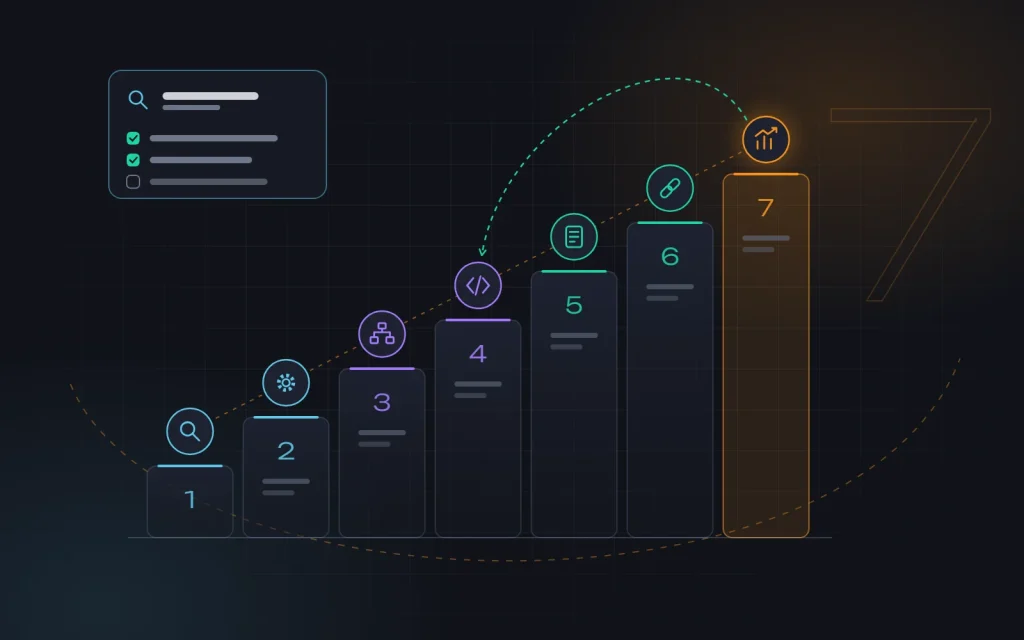
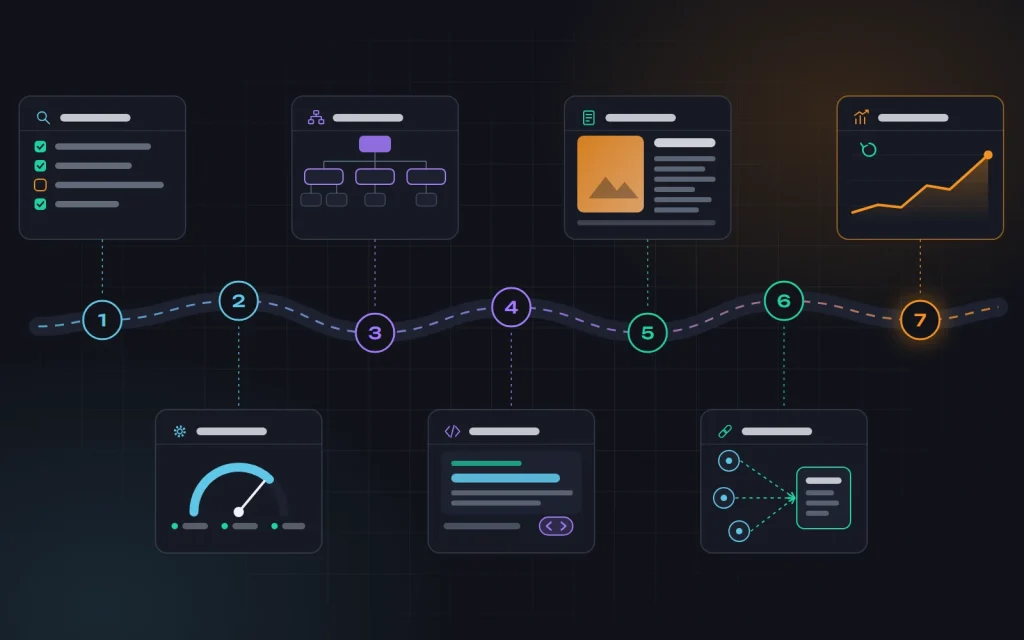
Here are the seven stages every one of our projects goes through:
- Audit and baseline: what exists today and how to measure it.
- Technical foundation: the site is accessible, fast and easy for crawlers to understand.
- Structure and keyword research: which pages are needed, and for which queries.
- On-page optimization: each page clearly answers its own set of queries.
- Content: copy that answers real questions and leads to an enquiry.
- Links and mentions: amplifying what already works.
- Analytics and iteration: measure, decide, go back to the right step.
Step 1. Audit and baseline
Before changing anything, record where you’re starting from. Without that, three months later there’s no honest answer to “did it work?” We’ve seen many projects where analytics was set up after the changes went live, leaving nothing to compare against.
What goes into our initial audit:
- Analytics. GA4 with conversions on real actions: form submissions, calls, clicks to WhatsApp, Telegram or Viber, purchases. Search Console with a verified domain property. If these aren’t in place, they’re the first thing we set up.
- Indexing. How many pages Google considers worth indexing, how many are excluded and why. A gap between the number of pages on the site and the number in the index immediately shows the scale of the problem.
- Current visibility. Which queries the site already gets impressions for, which pages get clicks, where rankings sit just below page one.
- Competitors. Who actually ranks for your key queries, how their sites are structured, how many pages they have per topic, what types of content they publish.
- Business context. Which services or categories make money, what the margins look like, which regions matter most. SEO that drives traffic to your least profitable lines is bad SEO.
The outcome of our audit isn’t a hundred-page PDF. It’s a short, prioritized list of issues plus a recorded baseline: clicks, impressions, conversions, number of queries in the top 10. Those are the numbers we measure the effect of every later step against.
We score every issue on two things: how much it holds back growth, and what it costs to fix. A blocked category that brings in half of all sales is priority one, even if the fix is hard. Missing alt text on decorative icons goes to the back of the queue.
Step 2. Technical foundation
Technical work comes second for a simple reason: everything we do afterwards has to be reachable by search engines. If a crawler can’t fetch a page, can’t tell which of several duplicates is the main one, or sees a broken layout on mobile, neither copy nor links will help.
At this stage we check and fix:
- robots.txt and the
robotsmeta tag: make sure important sections, CSS or scripts aren’t blocked by accident; - status codes: no broken links, redirect chains or soft 404s;
- duplicates: www and non-www, trailing slash or not, sorting parameters, print versions; all of them should resolve to one URL via a 301 redirect or
rel="canonical"; - the XML sitemap: only indexable pages that return 200;
- speed and Core Web Vitals, mobile first;
- the mobile version: Google evaluates the site based on it, so it has to carry the same content as desktop. More on this in “Succeeding with mobile-first indexing”;
- HTTPS with no mixed content.
The technical stage doesn’t mean fixing every last detail. We fix what blocks indexing and ranking and put cosmetic issues in a backlog; otherwise the work drags on for months with no visible movement. Speed and performance work is something we handle as a separate website speed optimization service.
Step 3. Structure and keyword research
Once the site is technically healthy, you can decide which pages it should have. This is the most often skipped stage: owners jump straight to copy without knowing which queries it should target.
A keyword map isn’t a list of words to sprinkle into text. It’s a map of demand: how people phrase their need, which groups of queries exist, and how many pages you need so that each group gets a precise answer. Our process looks like this:
- Collect queries from Search Console, a keyword planner, competitor research tools and the site’s own internal search.
- Clean out what doesn’t fit: other regions, services you don’t offer, informational queries with no link to the business.
- Cluster by search results: if Google shows the same pages for two queries, that’s one page on your site; if the results differ, that’s two.
- Assign each cluster to one page, either an existing one or one that needs to be created.
- Turn that into a structure of sections, navigation and URLs.
We’ve covered how to do this yourself in detail in “Building a keyword map”.
Why here? Not earlier, because without a technical foundation new pages may never get indexed. Not later, because changing URLs after pages have been optimized and linked to loses some accumulated authority, even with redirects. It’s cheaper to rebuild the structure once, before money goes into it.
Step 4. On-page optimization
Now every page has its own cluster of queries, and it can be tuned precisely for it. On-page optimization is work on the elements search engines read first:
- title and meta description: the cluster’s main query and a clear benefit, without stuffing. For large sites, templates rather than hand-written tags;
- H1 and subheadings: a logical hierarchy that reflects what the page is actually about;
- internal linking: important pages get links from navigation, related sections and blog posts, with anchor text that describes the destination;
- structured data: Organization, BreadcrumbList, Product, FAQPage where it matches what’s really on the page;
- images: alt text, modern formats, explicit dimensions.
We deliberately put internal linking at this stage. Before the structure exists, links between pages get placed at random. Once the structure is fixed, we know which pages are the priority and how to distribute internal authority between them. For a closer look at each element, see “On-page SEO basics”.
Doing on-page work before bulk content also gives fast feedback. A new title and H1 on a page that already gets impressions often shows up in Search Console within weeks, telling us which wording works and which pages need deeper work. That makes the next step far more precise.
Step 5. Content
Content comes after structure and on-page work not because it matters less; it often drives the biggest gains. But for copy to work, you need to know which page it’s for, which queries it answers, and where it sits in the customer journey. The previous steps gave us all three.
In practice, content work splits into two streams:
| Content type | Job | What matters |
|---|---|---|
| Commercial pages: services, categories, product pages | Turn a visitor into an enquiry or a sale | Specifics, prices or price ranges, benefits, terms, answers to objections |
| Informational pieces: articles, guides, comparisons | Capture queries that commercial pages don’t answer | Expertise, clear structure, links to the relevant services or categories |
We always start with commercial pages: they’re closer to revenue, and updating their copy usually pays off faster. The blog runs as a second stream, and every article is tied to a cluster that no existing page covers. That way an article and a service page never end up competing for the same query. How we plan and write that kind of material is covered in “Writing content for your website”.
Step 6. Links and mentions
Links are where many people start, and where the most money gets lost. External links strengthen pages; they don’t replace them. A link to a broken, irrelevant or thin page never pays back.
So we start link work only when:
- the pages we’re pointing links at are indexed and load quickly;
- they match the query precisely and already get impressions in Search Console;
- there’s something worth showing to the person who clicks through.
What we consider legitimate sources: niche directories and business profiles, mentions in industry media, partner sites, expert articles with a named author, reviews on independent platforms. What we don’t do: bulk link buying on marketplaces, networks of look-alike sites, “you link to me, I link to you” schemes. Links like that can give you a short spike and a long list of problems.
A word on pace. We grow the link profile gradually and prioritize pages already sitting in positions 5 to 20: that’s where an external signal most often produces a visible result. Pages still on page three of the results usually don’t need links; they need better content.
The best links appear when the site has something worth linking to: a useful calculator, a thorough guide, an honest comparison. That’s why strong content in step five makes step six cheaper and safer.
Step 7. Analytics and iteration
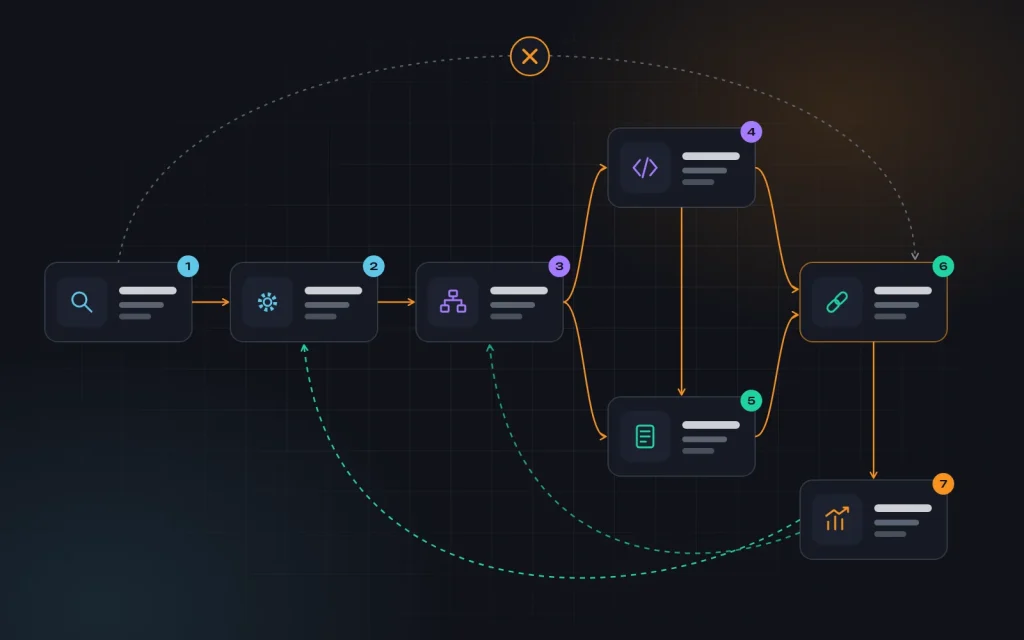
The last stage isn’t really the last. It turns a linear sequence into a loop. Once a month we compare current data with the baseline recorded in step one and decide where to go back to.
What we look at:
- organic clicks and impressions by page type, not just site-wide totals;
- the number of queries in the top 3 and top 10;
- CTR on pages with high impressions, a signal that the title and description need rewriting;
- conversion of organic traffic into enquiries or purchases;
- the indexing report: sudden changes almost always point to a technical problem.
The main rule of iteration is to go back to the step where the problem started, not the step that’s easiest to do. CTR dropped? That’s step 4. Pages stopped getting indexed? Step 2. New queries showing up with no page to land on? Step 3. If you answer every problem with more links or more articles, the root cause stays exactly where it was.
Give changes time, too. Search engines need to recrawl and re-evaluate a page, so we wait at least three to four weeks and compare like-for-like periods before deciding. Otherwise there’s no way to tell which change worked.
Here are the dependencies between stages in one table:
| Stage | Builds on | What you lose by doing it too early |
|---|---|---|
| Technical foundation | Audit | You fix the wrong things first and can’t measure the effect |
| Structure and keyword research | Technical foundation | New pages don’t get indexed or end up as duplicates |
| On-page optimization | Structure and keyword research | Meta tags and internal links have to be redone after the structure changes |
| Content | Structure and on-page work | Copy with no target queries, pages cannibalizing each other |
| Links | All previous stages | Authority flows to pages that can’t make use of it |
| Iteration | The baseline from the audit | Decisions get made on gut feeling |
What this looks like in practice
A typical situation: a company offering services in several cities. The owner has been paying for links for a year; rankings go up and down, but organic search brings in almost no enquiries. In the audit we find that the city pages are copies of one page with the city name swapped, half of them excluded from the index as duplicates, the mobile version loads slowly, and analytics tracks conversions on only one of five forms.
We don’t add a single new link at the start. First we set up conversions on every form, call and messenger click so we can see the real picture. Then we fix speed and duplicates. After that we research demand separately for each city and each service, and it turns out some cities don’t have enough demand for a dedicated page, while others need two or three. We rebuild the structure, write unique copy with local detail, and set up internal linking. Only once pages are reliably indexed do we return to links, selectively, for pages in positions 5 to 20. We don’t promise specific numbers; they depend on the niche. But in this order, the budget works toward results instead of fixing earlier mistakes.
The most expensive ordering mistakes
- Links before technical fixes. Authority goes to pages crawlers can’t see or treat as duplicates.
- Copy before keyword research. Articles “about everything” don’t reach the top for any specific query.
- A redesign after optimization. New templates wipe out meta tags, structured data and internal links, and changing URLs without redirects throws away what was built up.
- Analytics “later”. Without a baseline you can’t prove the work delivered results, or decide what to do next.
- Everything in parallel. When five workstreams start at once, none gets finished, and you can’t tell their results apart.
- An endless technical phase. Perfect code with no content or structure still brings no traffic.
A short checklist
- GA4 with conversions and Search Console are set up, and the baseline is recorded.
- Key pages are indexable, with no duplicates or redirect chains.
- The site is fast on mobile, and the mobile version is complete.
- A keyword map exists, and every cluster has exactly one target page.
- Structure and URLs are locked in before large-scale optimization begins.
- Titles, H1s and internal links are aligned with the clusters.
- Commercial pages have specific, original copy.
- Links point to pages that are already indexed and getting impressions.
- Once a month: a report by page type and a decision on which step to revisit.
Frequently asked questions
Can several stages run at the same time?
Partly, yes. While a developer fixes technical issues, you can be researching keywords; while copy is being written for the first group of pages, you can do on-page work on the second. What matters is that, for any given page, a stage only starts once the previous one is finished for that page.
How long does the whole cycle take?
The audit and critical technical fixes take a few weeks. Structure, on-page work and the first wave of content usually take two to four months. The first changes in visibility often appear 4 to 8 weeks after the technical work; a noticeable rise in enquiries takes several months. We cover realistic timelines in “Growing traffic in six months”.
What if the site has already been promoted for a long time?
Start with an audit anyway. It often turns out that part of the work was done well and part was built on a broken foundation. In that case we don’t redo everything; we go back only to the stage where the problem began.
Are links needed at all?
In most competitive niches, yes. But their role is to strengthen strong pages, not to drag weak ones up. In narrow niches and local businesses, sites regularly reach the top thanks to technical quality, structure and content, with very few external links.
The bottom line
The methods of website promotion are no secret. Results come from the order: the audit shows what to do, the technical foundation makes the site reachable, keyword research defines the pages, on-page work tunes them to queries, content provides the answers, links amplify what already works, and analytics tells you where to go back to. Every step gets cheaper and more effective when the one before it is already done.
If you’d like us to look at your site and put together a step-by-step plan, get in touch. We run audits and provide end-to-end SEO services: from technical fixes to content, links and monthly reporting.

Need advice?
Tell us about the task — we will advise what to do, even if you end up working with someone else.