
Blog
Brochure site, corporate site or landing page?
“We need a website.” That is how most first conversations with our clients begin. The next question often stops a business owner in their tracks: what kind? Some want “a quick, cheap landing page”, others “a proper corporate site like the big companies have”, others “just a brochure site with our contacts”. The format usually […]
- 17 October 2026
- 16 min read
Articles
Brochure site, corporate site or landing page?
“We need a website.” That is how most first conversations with our clients begin. The next question often stops a business owner in their tracks: what kind? Some want “a quick, cheap landing page”, others “a proper corporate site like the big companies have”, others “just a brochure site with our contacts”. The format usually gets chosen by how it sounds or by budget, not by the job the site has to do. Six months later it turns out the landing page brings in nobody from search, and the forty-page corporate site has nobody to fill it.
Below we walk through the three most common business website formats the way we do in first client meetings: how they differ, which goals they serve, what time and money they take, and what they can realistically achieve in SEO. At the end: questions to help you choose, common mistakes, a checklist and an FAQ.
Three formats, briefly and without jargon
“Brochure site”, “corporate website” and “landing page” have no strict definitions, and different agencies put slightly different things under each label. So let us first agree on what we mean.
Brochure site
A small website of 3–7 pages: home, services, about, a few examples of work, contacts. Its job is to confirm the business exists, show what it does and make contact easy. It is usually opened by people who already heard of you from friends, social media, your sign or Google Maps. They are not comparing ten companies; they are checking whether you can be trusted.
Corporate website
A full company website with dozens, sometimes hundreds of pages: one per service or business line, case studies, team, pricing, a blog or knowledge base, careers, documents, language versions. The key difference is not the page count but the fact that such a site is a customer acquisition channel in its own right: it works with search traffic, answers different audiences’ questions and grows with the business.
Landing page
A landing page is one long page built around a single offer and a single target action: send an enquiry, book, buy, download. Everything on it serves that action: the offer above the fold, the benefits, answers to objections, social proof, the call-to-action button repeated down the page. A landing page works best with traffic you bring in yourself, from ads, email or social media, when visitors already know why they are there.
A side-by-side comparison
Here are the key differences in one table. Timelines are indicative, from our own custom-design projects. Budget is relative, because the actual figure depends on content volume, design and integrations.
| Criterion | Brochure site | Corporate website | Landing page |
|---|---|---|---|
| Main goal | Trust and contact | Customer acquisition and reputation | Converting one offer |
| Size | 3–7 pages | 15–20 pages and up | One page |
| Typical timeline | 2–4 weeks | 1.5–4 months | 2–4 weeks |
| Relative budget | Low | Highest | Low to medium |
| Main traffic source | Direct visits, referrals, maps | Search, plus every other channel | Ads, email, social media |
| SEO potential | Limited: brand plus a few queries | Highest: hundreds of queries | Minimal: one intent |
| Scalability | Easy, if the structure allows it | Built in from the start | Hard: it is a separate product |
| Ongoing support | Minimal | Regular: content, SEO, updates | Tests and tweaks for ad campaigns |
A brochure site and a landing page cost and take roughly the same, yet solve completely different problems. That is where people most often go wrong: they pick “something affordable” and get a tool built for another job.
Start with the goal, not the format
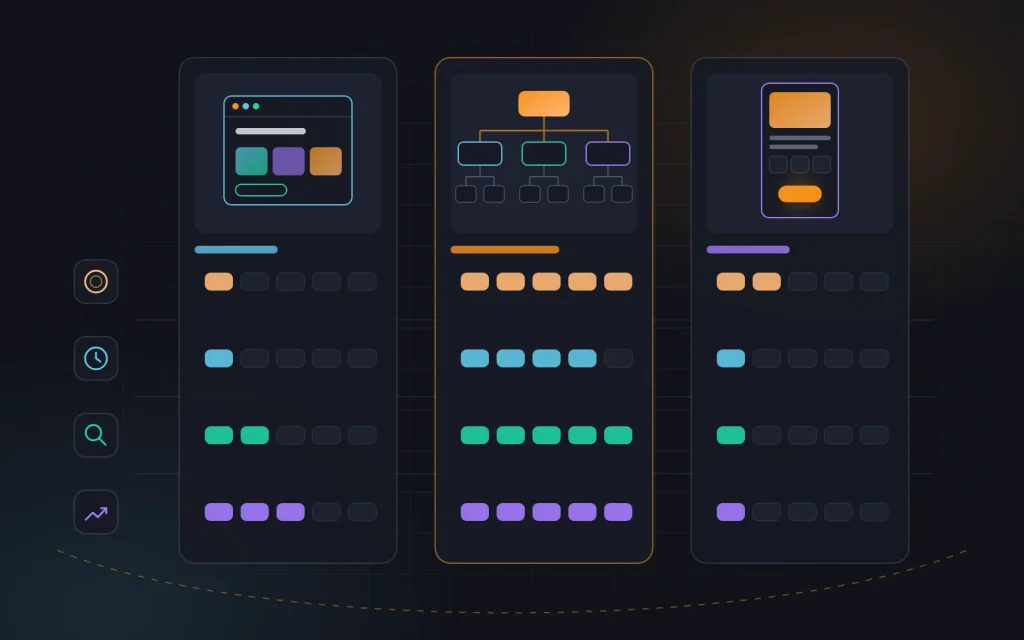
We always ask clients to finish one sentence: “Six months after launch, the site will be a success if…”. The answer almost always points to the right format better than any comparison table.
- “…people who heard about us from friends can quickly check us out and call.” That is a brochure site. You need trust, clearly described services, real photos and contacts, not a hundred pages.
- “…we get enquiries from Google, not only from ads.” That is a corporate website. Organic traffic needs separate pages for different searches, and you cannot fit them all on one page.
- “…advertising for our new course or service pays for itself.” That is a landing page. One offer, one audience, one action, and the ability to test variations quickly.
- “…partners, investors and job candidates see a serious company.” A corporate website, even if sales do not go through it: sections about the company, the team, projects, documents and careers.
- “…we sell products online.” None of the three. If you have a catalogue with a cart and payments, you need an online store, which is a separate story. We cover it on our ecommerce development page.
If there are several goals, we pick the main one for the coming year and build around it, with a structure that lets the second goal be added later without a rebuild.
Budget and timelines: where the difference comes from
Clients are often surprised that a corporate website costs several times more than a brochure site when “the design looks similar”. The difference is not in the home page design. Here is where it actually comes from:
- Structure planning. For a brochure site this is a few hours of conversation. For a corporate website it means keyword research, grouping queries, a sitemap and prototypes of the key templates. It is a separate stage that often takes weeks.
- Number of templates. A brochure site needs 3–4 unique layouts. A corporate site may need 10–15: service, case study, article, team, vacancy, branch contacts, city page.
- Content. The biggest hidden cost. Forty pages of 500–1,000 words each have to be written, approved and illustrated by someone. We explain how to prepare copy properly in “Writing content for your website”.
- Features and integrations. Multiple languages, CRM, calculators, client accounts, case study filters, schedules, online booking: each of these multiplies the development and testing effort.
- Approvals. The more pages and sections, the more people on the client side get involved. On corporate projects, delays usually come from approvals rather than from development.
A landing page is a category of its own. It is small, but every block on it works as a sales argument. A good one demands careful work on the offer, copy and visual hierarchy, plus testing after launch. A “two-day landing page from a template” and one that consistently pays back its ad spend are different products at different prices.
Remember post-launch costs too: hosting, domain, CMS and plugin updates, backups, content edits. For a brochure site that is little money and a few hours a year; a corporate site without regular care gradually loses rankings and relevance.
SEO potential: why a landing page does not attract organic traffic
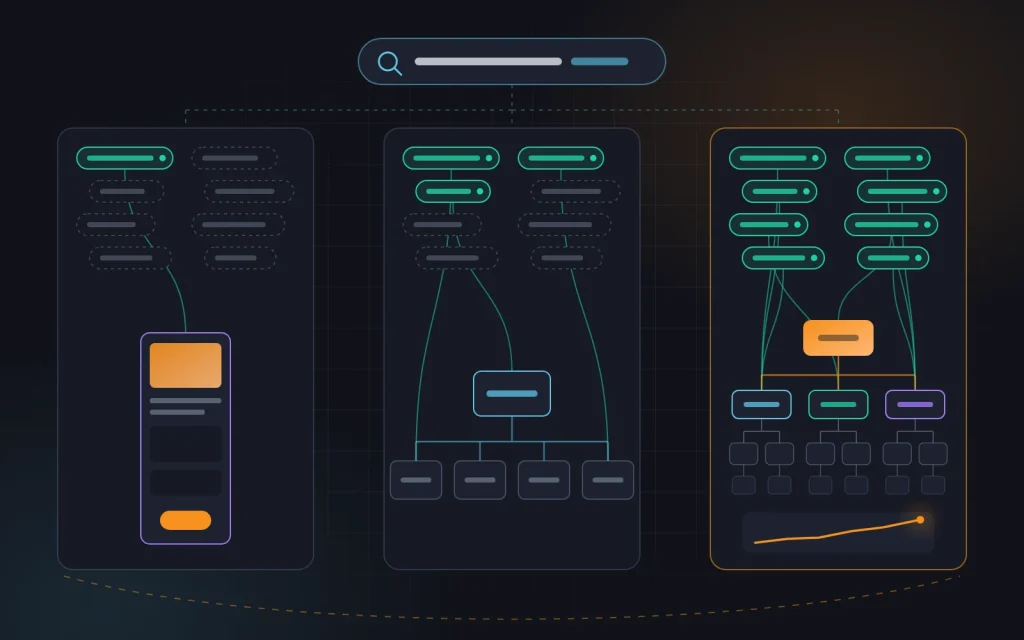
This is where most disappointment comes from. Search engines do not rank a website as a whole; they rank specific pages for specific queries. One page can answer one user intent well, along with a few closely related phrasings.
Take a dental clinic. People search for “dental implants”, “teeth whitening”, “children’s dentist”, “root canal under a microscope”, “dentist near me”. These are different needs with different questions and different search results. To rank for each of them, you need a separate page with its own title, H1, copy, prices and answers to common questions. We show how to collect such queries and map them to pages in “Building a keyword map”.
The conclusions are simple:
- A landing page can rank for your brand name and for one narrow query if competition is low. Trying to cram every service onto one page produces a page that answers nobody precisely, and it loses to competitors’ dedicated pages.
- A brochure site works well for branded searches and local search, combined with a Google Business Profile. If it has separate service pages, it can pick up a few dozen relevant queries in a small niche.
- A corporate website is the only one of the three that can grow systematically in organic search: new services, locations, case studies and blog posts are new pages for new queries.
One caveat: a large site guarantees nothing by itself. Forty empty or near-identical pages achieve less than seven well-crafted ones. Structure, meta tags, internal linking, speed and correct indexing are the foundation we described in “On-page SEO basics”. Without it, even the perfectly chosen format will not show up in search.
Hybrid options: how to grow without a rebuild
In practice, the choice is rarely final. Many of our clients start with one format and gradually move to another. The key is to plan for it at the start.
A brochure site that can grow
If the budget only allows a small site for now, we build a brochure site on a proper CMS, with a separate page for each key service and well-planned URLs. A year later you can add a blog, case studies and new services, and it gradually becomes a corporate website. No URL changes, no lost rankings, no redesign from scratch.
The worse scenario is a one-page brochure site with anchor links on a website builder. To develop it further you have to rebuild everything, which always means indexing risk and new costs.
Corporate website plus landing pages
For companies that advertise actively, we often recommend a combination: the corporate site handles search and reputation, while landing pages serve individual ad campaigns. They live on the same domain, for example under /promo/, share the visual style and stay out of the index if they duplicate main pages. Ads then do not compete with organic search, and analytics sees the full customer journey.
A landing page to test an idea
A new product line or a startup often makes sense to launch with a landing page: fast, affordable and with a clear metric, namely how many enquiries the ads bring and at what cost. If demand is confirmed, a full website comes next. If not, you have lost weeks rather than months.
For such a landing page to produce useful data, we set up analytics from day one: where visitors came from, where they dropped off, how many enquiries each campaign generated. These numbers later shape the full website: you will know which arguments convince your audience and which wording works, and the best-performing blocks move onto the new site instead of being rewritten.
What every format must include
Whatever you choose, there is a minimum without which the site will not do its job. We check these points before every launch.
On a brochure site
- A clear statement above the fold: who you are, what you do and for whom, without generic phrases like “quality and reliability”.
- A separate page, or at least a separate block, for each key service.
- Real photos of the team, the office and your work instead of stock images.
- Full contact details: phone, messaging apps such as WhatsApp, Viber or Telegram, address with a map, opening hours, and the same details on the site, in your Google Business Profile and on social media.
- A simple contact form with two or three fields.
On a corporate website
- A sitemap based on search demand, not on the company’s internal org chart.
- A service page template: description, who it is for, steps, prices or how pricing works, case studies, FAQs, a call to action.
- Case studies or a portfolio with specifics: the task, the solution, what changed.
- A blog or knowledge base, if someone can actually maintain it.
- Site-wide trust signals: team, certifications, reviews, company details.
- Analytics with goals for every form, phone call and messaging app click.
On a landing page
- An offer that answers “what do I get, and why here?” within a few seconds.
- A match with the ad: visitors should see exactly what they clicked on.
- Answers to the main objections: price, timing, guarantees, risks.
- Social proof: reviews, examples, partner logos if you have permission to show them.
- One target action, repeated several times down the page, with no distracting links.
- Fast loading on mobile: every second of waiting eats into the traffic you paid for.
Six questions we ask before we start
If you are still undecided, answer these questions honestly. We go through them in the briefing with every new client.
- Where will visitors come from? Mostly from ads: a landing page. If you are planning on search traffic: a corporate website. From referrals and maps: a brochure site is usually enough.
- How many services or business lines do you have? One: a landing page or a brochure site. Three to five for different audiences: at least a brochure site with separate pages. Ten or more: a corporate website.
- Who will keep the site updated? A corporate website without someone responsible for content ages quickly. If there is no such person, start smaller.
- How long do customers think before buying? An impulse decision is well served by a landing page. A long decision with comparisons, as in B2B or high-ticket services, needs many pages with arguments, case studies and answers.
- Do you need several languages or regions? Language versions, branches and city pages almost always mean a corporate structure.
- What will change in a year? New services, markets, vacancies: build them into the structure now, even if you implement them later.
Typical situations from our practice
Typical situation one: a small law firm ordered a landing page and launched ads. Enquiries came in at a high cost, and search brought nothing, because one page was trying to sell company registration, family law and transaction support at once. We split these areas into separate service pages, added an FAQ block and a few articles. Ads started pointing to the relevant pages, and search queries gradually began to appear in Search Console.
Typical situation two: a manufacturer wanted a sixty-page corporate website “like the market leaders have”. At the briefing it turned out nobody could write the content, and most customers came through distributors anyway. We proposed a twelve-page extended brochure site with a proper structure and room for future sections. It launched much sooner and was expanded once there were resources for content.
The mistakes we see most often
- A landing page instead of a website, to save money. Followed by expecting enquiries from Google that a single page cannot deliver.
- A corporate website “to grow into” with no content plan. An empty “News” section whose latest post is two years old hurts trust more than having no news section at all.
- Everything on the home page. Services, prices, case studies and contacts in one long scroll instead of separate pages, so none of the services ranks.
- A website builder with no room to grow. A cheap start, then a complete rebuild a year later with the risk of losing rankings.
- Copying a competitor’s choice. They may have a different sales model, different channels and a different budget.
- Ignoring mobile. Most visitors arrive on a smartphone, and Google evaluates sites primarily by their mobile version. More in “Succeeding with mobile-first indexing”.
A short checklist before you order
- You have one main goal for the site over the coming year.
- You know which channels visitors will come from.
- You have listed the services or business lines that need their own pages.
- You know who will prepare copy, photos and case studies.
- You have chosen a CMS that lets the site grow without a rebuild.
- You have budgeted not only for development but also for post-launch support.
- Analytics and goals are set up so that in six months you can measure results in enquiries.
Frequently asked questions
Can a landing page be promoted in Google?
Yes, but only to a limited extent. One page can reach the top for your brand and one narrow query where competition is low. Steady search traffic across many queries requires separate pages, which means a different format.
What is best for a new company on a tight budget?
Most often, a brochure site with separate pages for key services, built on a CMS that can be extended. It gives you trust, local search visibility and a base to grow from. If your sales will come from advertising a single offer, start with a landing page.
Can a brochure site be turned into a corporate website?
Yes, if that was planned from the start: a proper CMS, logical URLs, separate page templates. Then new sections can be added gradually. If the brochure site is a single page with anchor links on a website builder, it is simpler and safer to build a new site.
How many pages should a corporate website have?
As many as there are real customer needs you can answer well. The number is defined by search demand and your services, not by the wish to look like a big company. Twenty strong pages work better than a hundred empty ones.
Summary
A brochure site proves you can be trusted and makes contact easy. A corporate website attracts customers from search and grows with the business. A landing page turns ad traffic into enquiries for a single offer. No format is better than the others in itself. The best one is the one that fits your goal, your traffic channels and the resources you have for ongoing support.
If you would like help deciding, get in touch. We will look at your situation, suggest a format and structure, and after launch we can help with SEO and website speed optimization, so your site does not just look good but actually brings in customers.
Next
Read more

How to write a website specification
“We need a modern website, like our competitors have, only better.” Many of our first client conversations start this way. The owner knows the business inside out but has no reason to know what a website is made of. The trouble is that everyone on the project pictures that “modern website” differently: the designer sees […]

How much does a website cost
“How much does a website cost?” is the question we hear most often, and we always answer with another: what kind of website? A simple brochure site that goes live in a few weeks and an online store with inventory sync, payments and customer accounts differ not by percentages but by multiples. Owners also often […]
Need advice?
Tell us about the task — we will advise what to do, even if you end up working with someone else.