
Blog
SEO that actually works
Ranking factors that genuinely move the needle, and the ones talked about far more than they deserve.
- 14 September 2026
- 16 min read

Articles
SEO that actually works
So much has been written about ranking factors that site owners easily get lost. One contractor says push keyword density to 3%, another suggests a domain with the keyword in it, a third insists every page needs two thousand words because “Google loves long articles.” Some of this once made sense, some never worked, and some is lifted out of context. The budget ends up on things that are easy to explain in a report rather than things that actually move a page up.
At WebTerra we see every day which changes produce growth and which produce nothing for years. In this article we split ranking factors into two groups: the ones that genuinely move the needle, and the ones talked about far more than they deserve. No magic, no secret formulas — just the things we spend our own time on in client projects.
How a search engine actually picks a page
There is no list of “200 factors” where each adds points and the total decides your position. Modern search works more like a sequence of filters. The engine has to find the page and index it, then understand which query it answers, then compare it with other candidates on usefulness, authority and ease of use. Only at the end do small signals order pages that are already close in quality.
That leads to a simple working rule: factors don’t add up, they multiply. If a page is blocked from indexing, a perfect text on it is worth zero. If the text doesn’t match what the searcher wants, no amount of links will keep it in the top results. That’s why we always start with the foundational layers and only then move on to fine-tuning.
| Layer | The question the search engine asks | What we work on |
|---|---|---|
| Accessibility | Can I find, crawl and index this page? | robots.txt, status codes, canonical URLs, speed, mobile version |
| Relevance | What is this page about, and does it match the intent of the query? | Keyword research, page type, headings, text structure |
| Quality | Is it better than the alternatives? | Depth, originality, expertise, freshness |
| Authority and trust | Do others link to it, and can the author and company be trusted? | Links, mentions, E-E-A-T, reputation |
| Satisfaction | Do people find what they were looking for here? | UX, speed, clear presentation, no intrusive pop-ups |
Matching the query and its intent: factor number one
Most pages that “just won’t grow” are held back not by weak links or slow hosting, but by a plain mismatch. Someone searches for “washing machine repair price” and expects prices, turnaround times and a booking button. Instead, the site offers an article on the brand’s history or a generic “Services” page with one line about washing machines.
Search engines stopped judging pages by matching words a long time ago; they judge them by matching intent. The simplest way to work out the intent is to open the results for your target query and look at what’s already ranking:
- Commercial intent — the top results are product pages, categories and service pages with prices. An article won’t win this kind of results page.
- Informational intent — the top results are guides, how-tos and answers to questions. A category page usually loses here.
- Navigational intent — the person is looking for a specific brand or site. Competing for someone else’s brand is almost pointless.
- Mixed intent — the results contain both articles and stores. Either format has a chance, but each page should clearly commit to one.
The second part of relevance is completeness. If every page ranking for “how to choose an air conditioner” covers capacity, noise, inverter models and installation, and yours covers only capacity, it looks incomplete. The point isn’t copying competitors but covering every follow-up question a real person has.
In practice we do it like this: collect the keywords, group them by search results (if Google shows the same pages for two queries, that’s one page on your site), and decide the page type for each group before a single line of copy is written. We’ve described how to collect and cluster queries without expensive tools in “Building a keyword map”. It’s tedious work, but more often than not it’s the work that delivers the biggest gains.
Content and E-E-A-T: why “useful” beats “optimized”
SEO copy once meant a set number of keyword repetitions in set places. Today a search engine evaluates how well a page helps a person solve their problem. Google calls this “helpful, people-first content,” and we see it in the results: pages written “for the robot” gradually lose ground to pages written for the customer.
What quality content means for us in practice:
- The answer comes first. Price, timeframe, key takeaway — on the first screen, not after three paragraphs of introduction.
- Specifics instead of generic phrases. Not “we use high-quality materials,” but which ones, why, and what that means for the client.
- First-hand experience. Photos of real work, typical situations, mistakes you see, details nobody else mentions.
- A clear structure. Headings that describe the content, lists, tables, short paragraphs. More on this in “Writing content for your website”.
- Up-to-date information. Prices, terms, screenshots and recommendations that reflect how things are now.
A word on E-E-A-T — experience, expertise, authoritativeness and trust. It isn’t a technical signal you switch on, but a set of cues a search engine uses to decide whether a page can be relied on. They’re judged most strictly in health, finance, safety and legal topics.
What we add to client sites to make these cues visible:
- an “About us” page with real people, an address, a company story and documents where they exist;
- a named author for articles with a short description of their experience, not a byline that says “Admin”;
- full contact details, plus clear payment, delivery, returns and warranty terms;
- reviews, case studies and a portfolio with real examples of work;
- Organization, LocalBusiness or Article markup that helps the search engine connect the site with the business.
None of these alone puts a page first. Together they separate a real company from a fly-by-night page, and in competitive niches that becomes decisive.
Technical accessibility and internal links
Technical work rarely puts a site on top by itself, but it often keeps it at the bottom. We regularly see half the important pages unindexed while crawlers waste time on thousands of duplicates, filter combinations and search pages. What we check first:
- Indexing. Important pages return a 200 status, aren’t blocked in robots.txt or by noindex, and appear in the sitemap and in the Search Console report.
- Duplicates. One piece of content, one URL. Versions with parameters, with and without a trailing slash, with and without www — all consolidated with redirects or canonical tags.
- Mobile version. Google evaluates a site primarily by its mobile version, so content and links there must match the desktop. More in “Succeeding with mobile-first indexing”.
- Speed. Core Web Vitals in the “good” range: LCP under 2.5 s, INP under 200 ms, CLS under 0.1.
- Rendering. Key text and links are available in the HTML rather than appearing only after a click or heavy JavaScript.
One nuance about speed: it works as a threshold. A slow site loses both positions and visitors, but the gap between “good” and “perfect” barely affects rankings. So we fix the real problems — heavy images, unnecessary scripts, a slow server — as part of our website speed optimization work, but we don’t chase a PageSpeed score of 100 at the expense of functionality.
Internal links are among the most underrated tools, and entirely under your control. They tell a search engine which pages matter, how they relate by topic and how to reach them. A page linked only from the sitemap is almost invisible to a crawler.
Our working rules for internal linking:
- Key commercial pages sit no deeper than three clicks from the home page.
- Blog posts link to the relevant services or categories, and vice versa, wherever it makes sense to the reader.
- The anchor text describes the target page — “setting up store filters,” not “here” or “read more.”
- After each new article goes live, we add 2–4 links to it from pages that are already indexed.
- Once a quarter we look for orphan pages that nothing links to.
For more on tags, robots.txt and structure, see “On-page SEO basics”.

External links and behavioral signals
Links from other sites remain one of the strongest authority signals, but what counts now is quality and context, not quantity. One mention in an industry publication or on a partner’s site that real people read beats a hundred links from directories and link-selling sites. Aggressive paid-link schemes with identical anchors can lead a search engine to ignore them or trust the site less.
Where the links that work come from:
- partners, suppliers and manufacturers you genuinely work with;
- industry media where you can contribute an expert comment or article;
- your own research, calculators and useful reference tables that people link to naturally;
- local directories and business profiles — Google Business Profile and relevant industry listings;
- unlinked brand mentions that a single email can turn into links.
Behavioral signals spark the most debate. Search engines don’t disclose exactly how they use interaction data, so we won’t promise that “30 more seconds on site will lift your rankings.” But the principle is obvious: if people keep bouncing back to the results and picking another page, that’s bad news for yours. If they find their answer and keep exploring, that’s good news.
So instead of “faking engagement” (risky and pointless), we work on what makes a page genuinely easy to use: an honest, appealing title and meta description that raise click-through rate; the answer on the first screen; clear navigation; no pop-ups covering the text; fast loading on mobile. That’s SEO and conversion at the same time.
What’s overrated: factors talked about more than they deserve
Now the other side: what, in our experience, people most often spend money on without noticeable results. Some of these don’t hurt but don’t help; some worked once and became outdated; some are myths passed from article to article.
| What’s overrated | The reality | What we do |
|---|---|---|
| Keyword density | There’s no “ideal percentage.” Search engines understand synonyms and context, and stuffing looks like spam. | Keyword in the title, H1 and wherever it reads naturally; the rest in plain language. |
| Meta keywords tag | Google hasn’t used it for ranking in a very long time. | We leave it empty, except where a CMS uses it for internal search. |
| Exact-match domain | Gives no special advantage; without a quality site it’s an empty name that’s hard to build a brand on. | We choose a short, memorable, brandable name. |
| Word count | Length is a result of a complete answer, not the cause of it. A long text about nothing loses to a short, precise one. | We set length by intent and competitors, not by a quota. |
| Meta description | Not a ranking factor, but it affects how often the snippet gets clicked. | We write it for people, like an ad for the page. |
| Domain age | Age alone gives no advantage — what matters is the history: links, content, reputation. | We don’t buy “aged domains” for their age. |
| Bulk directory links | Most are ignored, and some damage the site’s reputation. | A few relevant sources instead of hundreds of random ones. |
| “Updating the date” without changes | Changing the date without changing the content doesn’t make a page fresh. | We update facts, prices and examples, and only then the date. |
The general logic is simple: if something can be done mechanically, without thinking about the customer, its effect has most likely been neutralized long ago. Search engines have spent years learning to ignore exactly these kinds of signals, because they’re the easiest to fake.
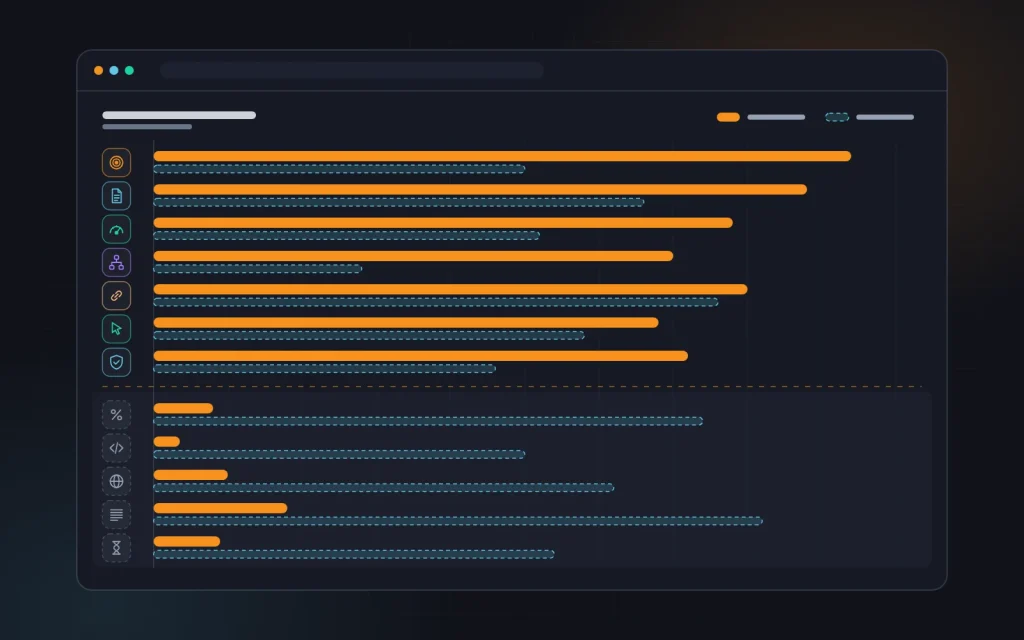
Other things we don’t treat as priorities: an exact number of H2s per page, “LSI keywords” as a list to paste in, a mandatory block of text on the home page, and social likes as a direct ranking factor. Social media helps reach and headings help structure, but neither is a ranking lever.
What this looks like in practice
A typical situation: a repair services company with a site of around forty pages. The previous contractor spent two years “optimizing” the copy — 4% keyword density, two to three thousand words on every page — and regularly bought directory links. Rankings are flat, organic enquiries are few, and the reports show a growing “number of backlinks.”
The audit shows several key services lumped onto one general page, so the search engine has nothing specific to show for specific queries. Some pages are duplicated through URL parameters, the mobile version hides prices in an accordion that won’t open, and the copy never gives a price or a timeframe.
What we do, in this order:
- Fix the technical problems: duplicates, canonical tags, the mobile version, speed.
- Split the general page into separate pages for each service with real demand.
- Rewrite the copy: price and timeframe at the top, photos of work, answers to common questions, no artificial keyword repetition.
- Build internal links between services, the blog and the contact page.
- Drop the directory links and pursue a handful of mentions from partners and industry resources.
The first changes in indexing and visibility usually show up within a few weeks, and a noticeable rise in enquiries within a few months. Exact figures depend on the niche and the competition, so we don’t promise them up front. But the direction is visible in analytics: more queries in the top 10, a higher click-through rate, more calls and form submissions from organic search. We’ve written about how to sequence the work so that each step builds on the previous one in “Website promotion step by step”.
How do you know the changes worked because of the right factors and not by chance? We don’t look at the position of a single “main” keyword; we look at several metrics together:
- The number of queries a page appears for in Search Console — it grows as relevance and completeness improve.
- Snippet click-through rate — responds to title and description changes within a few weeks.
- The share of pages indexed out of those that should be — the main indicator of technical health.
- Enquiries, calls (including WhatsApp, Viber and Telegram messages) and sales from organic search — the only metric the business truly cares about.
If visibility is growing but enquiries aren’t, the problem usually isn’t the SEO factors but the page itself: the price, the offer or how easy it is to get in touch. That’s something your reports should show honestly, too.
A short checklist
- Important pages are indexed, free of duplicates and return a 200 status.
- Each keyword group has one page of the right type.
- The answer to the query is visible on the first screen.
- The copy contains specifics and first-hand experience, not keyword repetition.
- The site makes clear who is behind the company and how to contact them.
- The mobile version is complete, and Core Web Vitals are in the green.
- Key pages are within three clicks and have internal links pointing to them.
- External links come from relevant sources, not directories.
- Reports show clicks, enquiries and revenue, not just “density” and backlink counts.
Frequently asked questions
Do I still need keywords in my copy at all?
Yes. The search engine needs to understand what the page is about, and the visitor should see their query reflected in the heading. But using the keyword in the title, the H1 and naturally in the text is enough. Counting percentages and repeating the phrase artificially makes no sense.
Which matters more, content or links?
Relevance and content come first. Links strengthen a page that already deserves to rank, but they won’t rescue one that doesn’t answer the query. In competitive niches you can’t do without quality links either, so we work on both — in the right order.
Should I write long texts to rank better?
Write complete texts. Sometimes 300 words and a price table are enough; sometimes you need a guide several thousand words long. Go by what the reader needs and what’s already ranking, not by a target word count.
How quickly do the right changes pay off?
Technical fixes often produce the first movement within a few weeks. Content and links build their effect over months. That’s why we judge results by the quarterly trend, not by week-to-week ranking fluctuations.
The bottom line
Effective SEO rests on a few pillars: the page is accessible to the search engine, precisely matches the intent of the query, is more useful than the alternatives, is supported by internal links and quality external ones, and has a real company visibly behind it. Everything else — keyword density, the meta keywords tag, exact-match domains, writing to a word count — takes up time that’s better spent on the fundamentals.
If you want to find out which of these factors are holding your site back, get in touch with us. We’ll run an audit, show you the priorities and, if needed, take on your SEO services end to end — with no artificial tricks and no “top spot in a week” promises.


Need advice?
Tell us about the task — we will advise what to do, even if you end up working with someone else.